
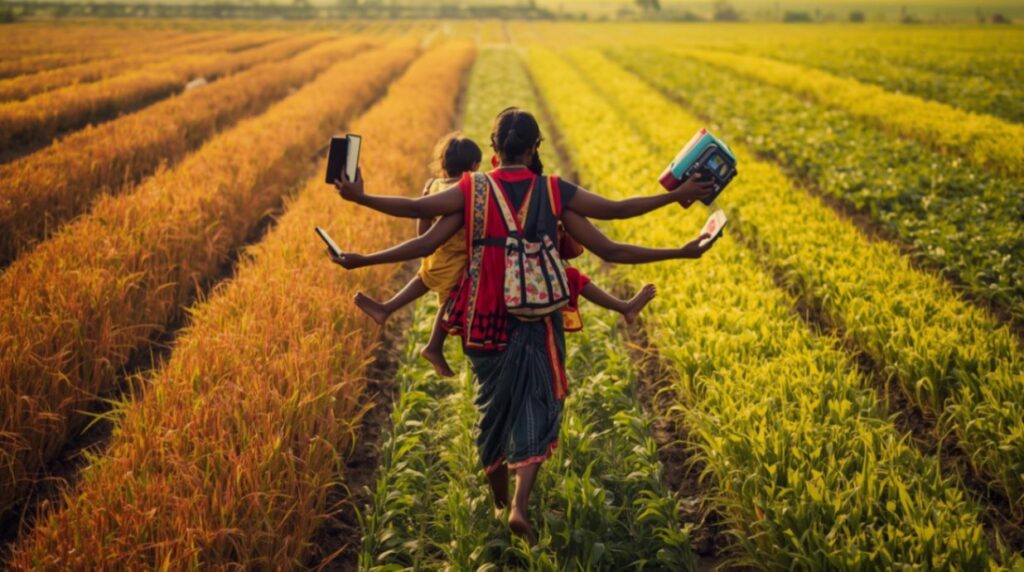
Someone who builds a home from nothing. Someone who carries generations on her back without ever asking for applause. Someone who absorbs pain, silence, and expectations until they become a second skin. The world calls her patient, adaptable, soft because it benefits from her endurance.
Society makes use of all the energy she possesses, then pretends it was effortless. Even held accountable possibly for the things out of her hands. Someone who is responsible for raising children, holding everyone together, keeping things in place, healing wounds yet unheard.
Someone worthless even after doing everything useful, the backbone of the institution called family, an easy target of culture and tradition. Someone always expected to bend and adjust but never complain, to give all but never demand, she carries quietly,
She is a woman.
A Different perspective
- Trapped between home and office, some women think they are living feminism. In the name of empowerment they are doing more than ever. They manage the house, raise the children, have the same roles as always, and on top of that carry office stress, transfers, workload, debt, endless expectations.
- They are doing double work. Working women benefit society. Earning money while holding the same traditional roles. Some women call it subtle control and have begun asking questions like “Is it good to be a working woman?”, but most do not even see it.
- Women have always lived in these two worlds. This is not new. They did it quietly, without titles, without recognition. So where was feminism then? Is reading and writing enough to call it empowerment if it only trains women to become obedient workers for some industry? And we dare to call this liberation?
A Matter of Concern
The education system is a lie. It sorts children not by creativity or intelligence but by obedience and grades, marking them as disciplined and ready to serve the workforce of big corporations. Anarchists, misfits, rebels are those who think out of the box, question things, and are perceived as a challenge to authority. Yet the scientists, poets, writers, and philosophers who shaped humanity come from the group called anarchists by this system.
- Still, many women break through. They begin questioning the authority, patriarchy itself. This so-called education sometimes forces them to think beyond the box, to do things they were never allowed to do. Gradually, they begin creating literature for other women, for society, for spreading awareness against patriarchy, teaching all to demand dignity, rights, and respect.
- The world treated women as second-class citizens. They were denied rights, pen and paper so that they can not represent themselves, so that they can be silenced. That is why the number of women writers, poets, thinkers, and philosophers has been historically low, not because they lacked expression, intellect and analytical thinking, but because society refused to let them write and think freely.
Invisible Labour in Villages
- What is the difference between a housewife and a working woman? Well, in villages, women have been working in agricultural fields for generations. This is not a modern concept. Generations of women have worked all day, sowing, to harvest, always without any recognition or pay for their labor. Their unnoticed contribution to agriculture and the survival of rural communities is enormous. Are they housewives just because they are not getting paid or their work has not been recognised.
- Apart from agriculture, women carry the responsibility of their family, prepares food. By raising the new generation, she keeps the society functioning with patience and resilience. Despite her effort, society rarely acknowledged her, and continues to undervalue the work that sustains both homes and communities. What is meant by working women? Does it mean working women in the workplace?
Power, Alcohol and Women
Men love to celebrate their manhood and often believe it is incomplete without alcohol. By law or by custom, no one dares question why he drinks. What power lies in that bottle? A man who is already privileged in a patriarchal society gains even more authority from alcohol, a sense of free will, aggression, and dominance to exert control over the soft target the world calls women.
- She suffers, is targeted for domestic violence, harassment. She was blamed if her husband dies from problems caused by drinking, as if she murdered him. Why does society still expect her to carry the weight of the household? In ancient times, men were responsible for food so they went hunting and gathered food and she took care of the household. Society has changed, but the roles remain rigid.
- Even many women who are called educated and financially independent now drink. Is this a rebellion in the name of empowerment? Are they chasing the thrill men have had for centuries? Do they seek the same charm, the same sense of freedom and power that comes with alcohol? Perhaps only they can truly answer that.
Family, honour and women
- What is honour? It is a word society uses to give value to a family for following its rules, norms, and expectations. Within ethnic groups, it becomes a shield for reputation, a way to control behaviour.
- I see it as a form of hypnotism, a subtle emotion designed to control people. It operates at the level of nations, societies, ethnic groups, and regions. We have witnessed people die for honour, and others kill in its name. What kind of honour is that, taking the life of your own loved ones?
- One persistent question remains why is a family’s honour always tied to a girl’s virginity and not the boy’s? Why is it so common in agrarian communities that children are murdered for honour? The roots lie in the caste system, economic patterns such as inheritance of land and property, deeply ingrained patriarchal norms, minimal oversight from the state, and tightly knit honour based cultural traditions.
He Cannot Know
Someone can be caring, sympathetic, forthright and even make noise for women’s rights, but would not be truly able to understand the struggle and pain they are going through under patriarchy. Someone can debate questions like “Why is it important to empower women?” or “What is the role of women in society?” yet still remain far from the lived truth.
The unheard pain, subtle loneliness, constant pressure and expectations to handle every problem within or outside the family cannot be realised without being faced.
Some are changing, many are learning, yet the ability to completely advocate for women is limited, shaped by inherited biases and social conditioning that even the best intentions cannot erase.
He is a man.